


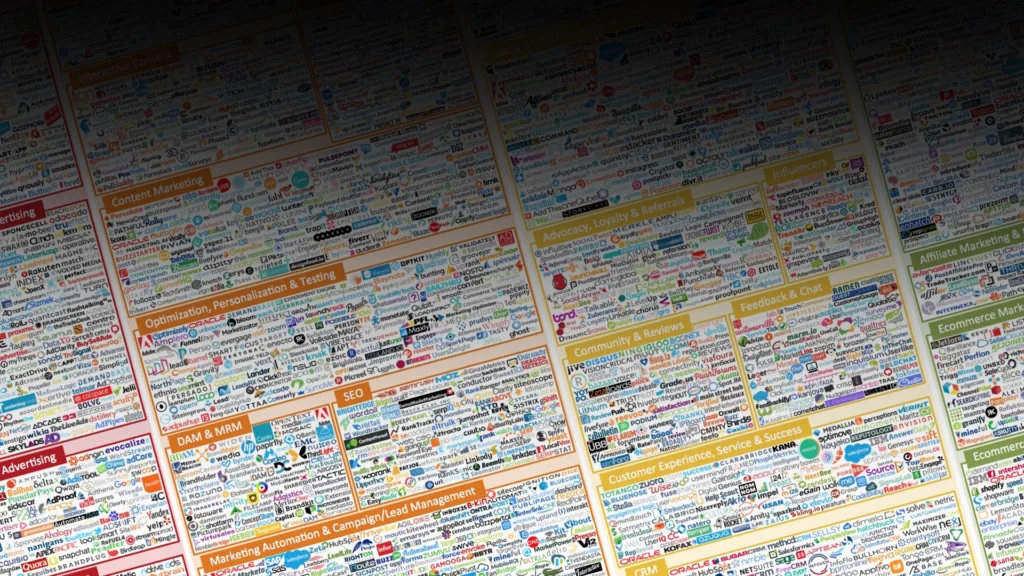
Recently, Scott Brinker published a fascinating graphic, with 3,874 marketing technology logos crammed into one chart. For every one of those logos and all the accompanying investor decks and analyst presentations, the underlying myth of how work actually gets done is the same: “The robot does it all.”
This conjures a vision of a vast, pristine room, at the center of which is a lonely marketing technology robot. No humans, no hubbub: the room is so quiet that somewhere in the distance you can actually hear cash registers ringing.
SaaS: The Digital Service Gap
In reality, the picture is quite different. For every mar tech robot that “does it all,” large service ecosystems grow up around it that combine technology, people, and processes. It’s true for paid search, for programmatic advertising, and for every logo crammed into that infographic.
The reason is simple: ad tech and mar tech SaaS models sell products, not services. There is a massive service gap, especially when it comes to the smaller businesses that the industry expects to drive technology adoption, because these advertisers aren’t in a position to buy products by themselves.
The SaaS model is built around two ideas. First, that doing most of the heavy lifting and putting that capability into the cloud will make things easier and more efficient for everyone. And second, that to the greatest extent possible the service work will be performed by some other company. That’s what makes the SaaS model attractive to the VC community: less burn and more margin.
And if you’re the customer, that’s all true – but only once you invest the time to learn the product. And get the right data in. And customize the tool to the produce the right output for your specific business. And analyze your results. And then make some tweaks based on what you learn. There a hundred other things that you need to do, and then keep on doing to realize those efficiencies.
That necessary work doesn’t magically vanish. It still has to get done. Without a team or some kind of service ecosystem to handle that work, it sharply limits the value SaaS products provide. In other words, we’re still a long way away from the vision of the lonely mar tech robot becoming a reality. There are five reasons why.
- Dumb is baked into the system. If you run a SaaS technology company, “dumb” is a feature, not a bug. The goal is to identify the core commonalities that all companies need and provide something basic that can work for everybody. But to leverage the real power of that software, each individual business requires some customization.
- A dashboard is not a driver. It’s hard to operate a dashboard if you have no idea what it means for your specific business. If a number goes up, is that good or bad? If it’s bad, what do you do to make the number go down? If it’s good, can you make the number go higher? Some expertise is always needed.
- Not all users are created equal. There’s a tremendous range of sophistication among users. Some have deep experience and plenty of time, and so require very little help. Some have scant experience and no time to scramble up the learning curve, and need a “do it with me” (DIWM) or “do it for me” (DIFM) solution.
- Marketing is a marathon, not a sprint. Today’s perfectly automated system is tomorrow’s anachronism. Market conditions change, customers change, competitors change, managements and strategies change. Advances in technology mean that all of these factors change faster, not slower. Yes, machines can adapt. But humans are still needed to steer that adaption in the right direction based on a set of experience-fueled hypotheses about the future.
- Keeping up to date is a full-time job. New technologies are being invented in every garage around the world. World-beaters in technology stumble, and new champions emerge with new capabilities that require re-integration with everything else in the company’s marketing stack. No matter how sophisticated a company’s system is now, it’s unlikely to be exactly the same next year.
The smaller the business, the bigger the Service Gap.
In enterprise, SaaS can work because there are big, existing internal teams ready to tackle the work. Even then, there are complete external ecosystems built around SaaS solutions like Salesforce.
For small and mid-sized businesses (SMB), it’s practically impossible: how many SMB owners can afford the team, time, or talent it takes to make these SaaS solutions work for their business?
Few SMBs have the time or expertise to make the most of even the simplest fully automated “do it yourself” ad tech or martech offerings. SMB churn is as high as 60% annually for many providers. Poor service levels from providers (55%) and poor program results (60%) are the top two reasons SMBs are dissatisfied with their current media providers, according to the Local Search Association. And untold numbers of DIY “solutions” get started and abandoned by SMBs every year.
For SMBs to truly benefit from digital, the Digital Service Gap needs to close. There are a tremendous number of SMBs who are ready to invest, but need “do it with me” or “do it for me” solutions. Without that help, SMBs can’t participate and grow their business the way they need to.
What’s more, closing the Digital Service Gap has a positive ripple effect across the entire ecosystem. When SMBs get the help they need, they can buy more digital media and get stronger results. And the same is true for ad tech and mar tech companies. What helps SMBs, in other words, helps everybody.
According to BIA Kelsey, businesses will spend $44.9 billion on local digital advertising this year, and that total will grow 60 percent by 2020. One day, perhaps the shining vision of the lonely martech robot will become a reality. But between now and then, there’s a lot of important – and human — work to be done.Originally published on BIA Kelsey Vantage Points.
